

Blog: Keeping Hope Alive: An Interview with Professor Khamis Elessi
 Cameron Don
 12th March 2026
One of Cairdeas’ closest friends and colleagues over the years has been Professor Khamis Elessi, from Gaza, who we have worked in partnership with to help deliver teaching and support to Palestinian healthcare workers, hospitals and students. Over the past few years of targeted attacks by Israel against healthcare workers in Gaza, Khamis has worked tirelessly to treat his patients, look after his staff and continue to educate the next generation of Gazan doctors.
During our recent Edinburgh conference, we heard from Professor Elessi, through an interview with Dr Mhoira Leng, whom he calls sister, where he spoke on keeping hope alive in the middle of genocide and his sense of a common humanity with all people:
M: We have been exploring the topic of rethinking coping and exploring hope in midst of conflict and change. We would love to hear your personal perspective on coping in a time of genocide and also exploring hope.
K: There are three main factors which help us to cope during these times of massacre and genocide: First is our religion, which gives us a strong foundation, that whatever happens to you has been destined. If we keep being patient and looking at things positively, we will be rewarded. We’ll be setting a model to others to withstand their sufferings, especially if you’re the head of your family, you’ll become a role model to your medical students or your junior colleagues. Second when we see our co-citizens, our fellow Palestinians are enduring even more harsh conditions than you, and they still put all praise to Allah and still find ways to continue with their lives despite the loss of their loved ones, their homes and belongings, their possessions and their life-long savings. They still aspire for a brighter tomorrow. If they can do it, why can’t I. Third, and most importantly, is the unprecedented international solidarity with Palestinians. When we see hundreds of thousands of people marching in the streets and gathering in every square around the globe to demonstrate for the sake of Palestine, we realise that we are not alone, that we have brothers and sisters in each corner of the world who are standing with us and supporting us and we are reassured that we are on the right path. We are humanitarians who want to help other humans to have a dignified life and to live pain free, to enjoy every basic human right that they deserve to have here in Gaza. When we see millions of people pouring into the street from all directions, in all different capitals of the world, we feel that, yes, there is hope. It makes us feel better despite all the hardship we’ve been enduring for the past 2 years.
M: One of the things I have learned from you over the years, particularly in discussions about palliative care, is that deep sense of humanity, which I saw in you and also saw in the culture and community of Gaza. Would you say more about the sense of being human together, what that means to you?
K: Being human, I think, is the most important ingredient in being a successful doctor, a successful healer, a successful compassionate leader. If you are not a human, you cannot feel the suffering of other humans as well, but if you truly are a human you can feel the pain of colleagues, patients, friends, neighbours, etc. Humanity is the common trade name for any person who wants to act and do what humans should do. When we see other humans in all continents feeling and sympathising with us, enduring violence, punishment, interrogation by authorities worldwide, and still insisting on supporting Palestinian humans as equal human beings like any other person, we feel that, yes, humanity is a common language – we are all humans, we are all created by the same creator, we all have the same rights and we all have the same obligations to save one another. If we all apply this, we feel strong, because we are not alone. We are not alone in Gaza, although there are only two million of us inside Gaza, but we have tens of millions of supporters worldwide. So, in reality, we are a strong nation, a global community comprised of tens of millions of humans, all living together on one planet called Mother Earth, and that is why we should stand next to each other and support each other and this is the secret that gives us more strength and more hope for a better and brighter tomorrow.
M: Thank you so much, I have been reading comments from some of your students recently, and I saw one which said that you were the professor that taught us empathy, which I think you have shown through this discussion. I also want to congratulate you on the honourary FRCPE - Fellowship of the Royal College of Physicians of Edinburgh and we look forward to welcoming you to Edinburgh soon to share that honour with you.
We are happy and relieved to share that, after 810 days of rendering noble services to patients inside Gaza, Khamis and his wife and six children have now reached safety in Oslo, Norway. They now face the new challenges of a new home in a new country, very different to the culture and climate of Palestine. Norway in winter means contending with lots of deep snow, something Khamis and his family are not used to, as well as the extremely expensive life in Oslo with new culture, new food and a new language.
Having lived through years of immense fear, massive losses in lives and assets, repeated displacement and violence from Israel, the adjustment to safety and security can be a surreal one. Khamis shared with us the words of his youngest son, who said to him “pinch my arm, pinch me so I can believe we got out of Gaza alive.”
We look forward to welcoming Khamis to Scotland soon and to continuing our work together, to keep supporting those still living in Gaza and West Bank, under the continued violence of Israel. If you would like to support Khamis, his family and our work in Gaza, please follow this link to our donation page, where you can select Gaza as the cause you wish to give to.
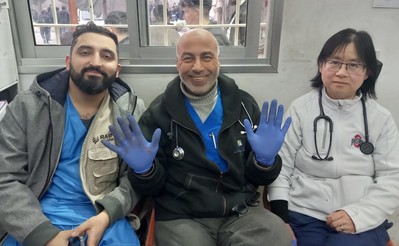
Khamis with medical colleagues in Gaza
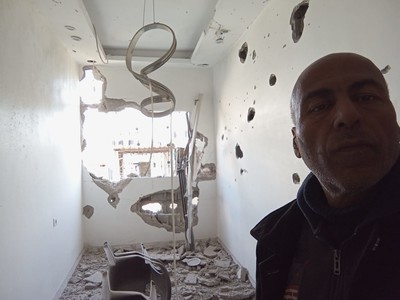
Khamis displaying the destruction caused by the Israeli attacks on Gaza
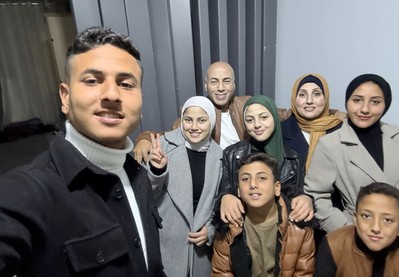
Khamis' family, including his wife and six children
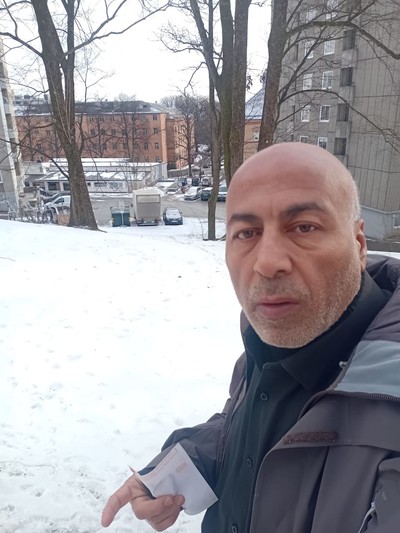
Norwegian winter is a new challenge for the family