

Blog: In Global Solidarity and Hope: An Interview with Dr Khamis Elessi
 Cameron Don
 20th August 2026
Recently, I sat down with Dr Khamis Elessi, one of Cairdeas’ longstanding partners and lead in Gaza. Specialising in Rehabilitation Medicine, Dr Elessi worked to save lives throughout the years of Israeli violence and is currently living in Norway with his family, having been forcibly displaced from their home many times over.
In June, Khamis visited Scotland to be inducted as a Fellow into the Royal College of Physicians of Edinburgh. I spoke to him about what it meant to receive this honour, the crises facing the Palestinian people and the ongoing situation in Gaza, and how people can help to support Palestinians.
Hi Khamis, it’s great to speak to you! You’re joining us from Norway but recently you were over in Scotland, receiving your FRCPE from the Royal College of Physicians of Edinburgh. Could you tell us what it meant to receive the FRCPE and become a Fellow at the Royal College?
Thank you so much for having me, and thank you for organising this interview. Actually, I was informed about this amazing news 6 months ago when I was back still in Gaza, that I was selected by the Council of the Royal College of Physicians of Edinburgh to become a full Fellow of the College. And that was amazing news, first to maybe pay back some of the sacrifice that we have made to help our people in Gaza. I have been volunteering to serve our people in Gaza City for 815 days during persistent and unprecedented bombardment inside Gaza Strip, alongside starvation and lack of medicine, lack of food, lack of salaries, lack of everything. But despite this, and with the help of our friends worldwide, their sentimental support, their support in every aspect really kept us going inside Gaza Strip.
And when I received this amazing news that I was selected to receive the Fellowship for the Royal College of Physicians of Edinburgh, that really became like a blessing down on my heart that, yes, my efforts haven’t been in vain, yes I’ve been acknowledged by this eminent college. So yes, it was a very, very emotional moment, very happy moment. Particularly when I came in person to Scotland and received the certificate myself in this spectacular celebration, it was once in a lifetime to be in such a celebration alongside my dear beloved sister Mhoira Leng and also Liz Grant, the director of the Global Health Academy. They were among the people who nominated me for this, so I’m really grateful for that and happy for that. It was a great day.
Thank you Khamis, I’ve seen some of the pictures and it looked like a really wonderful day, and we’re very pleased that Cairdeas could be part of that day with you through Mhoira.
You mentioned about feeling that support from colleagues in Scotland and around the world, could you speak a little bit about the sense of global solidarity that you feel for Gaza and Palestine?
Just imagine, you are stranded with 2 million Palestinians in this tiny enclave, and when Israeli forces ask all residents of Gaza City to leave Gaza City, they have to flee under bombardment, under shelling and go to live in tents for more than 900 days. I was among those people, with my family, to be asked to evacuate. But I decided I will stay in Gaza City, there were still 500,000 people remaining there with few doctors, few specialists, few healthcare systems, so I decided I will stay and serve my people with whatever I can do.
And in this time, when you feel you are surrounded from land, air, by bombs and starvation on the ground, lack of everything, and fear. When you receive these calls of support from your friends and colleagues worldwide, particularly my international friends, from Scotland and other places, you feel yes, I am not alone. I have brothers and sisters worldwide who think of me and support what I’m doing and they encourage me to continue. When I hear these words of many of my friends, who tell me they wake up to hear the news that comes from Gaza, and ask those people who are awake, “what happened to Dr Khamis in Gaza City, is he still alive or not?” this means a lot to me and shows true brotherhood and sisterhood from our friends and colleagues worldwide. Scottish people were amazing and are still amazing, great supporters of Palestinian people and Palestinian issues.
Cairdeas as an organisation has been very supportive in every aspect, particularly since we started the integration of palliative care and pain management into the Gaza Strip undergraduate curriculum and healthcare services. Together with Cairdeas, we were able to deliver tens of training courses and hundreds of lectures to medical students from different universities, particularly Islamic University Faculty of Medicine. With courageous support, we have managed to run courses twice online using hybrid teaching for our medical students, and even managed to ask students to visit hospitals and do practical applications of what they have learned with patients, paediatrics and others as well.
Thank you, I know we’re very happy to have done this work with you, and look forward to more work in partnership going forward.
During your visit, you also spoke at the Scottish Palestinian Health Partnership conference, focusing on the issue of traumatic disability in Gaza. Could you tell us about that issue and the challenges being faced?
When people hear about the atrocities committed in Gaza, they always hear about the number of Palestinians killed, number of Palestinians injured. Among the injured, we have more than 43,000, according to WHO, who will live with long term need for medical care and rehabilitation. Among those who need rehabilitation, we have 6000 individuals with amputations, including 3000 kids unfortunately. Children in particular, they need special kinds of prosthesis that need to be remodeled every time because they grow, and what they used to have as a prosthesis before will not fit later on, so they need refitting and reevaluation.
And this conference focused particularly on people with disabilities and people with amputations and how we can move forward. I think this is a very, very vital issues that will affect thousands of people for years to come. Thanks to the chair of the conference, Dr Phillippa Whitehead, who organised a visit to Strathclyde University Department of Prosthesis. We had a closer look at their manufacturing techniques, their equipment, some solutions for how we can deliver these techniques and strategies towards Gaza and serve them.
We can rebuild capacity in Gaza to serve the thousands of patients these, first through training and refresher courses to the current professionals inside Gaza, to give a boost and act now. Second, we need to start short term diploma courses to equip new local champions with knowledge, and they can join the prosthetists available in Gaza. Third, in the long term, is to select two or three among the current prosthetists in Gaza and provide them with a chance to study master’s degrees at Strathclyde.
I was really amazed to see in Strathclyde University that they have a new technology for measuring and gauging the prosthetic size that will fit exactly on the stump of the patient. It will save us a lot of time, money and effort in manufacturing prosthesis that is not the right size. So if we can copy this technology back to Gaza, I think we will save a lot of time and a lot of suffering for those patients.
Thank you, Khamis. For us in Scotland and the UK, the genocide in Gaza has disappeared from our news channels and headlines. Can you give us a sense of the ongoing situation in Gaza and what it’s like on the ground, and in healthcare settings.
Before the war, Gaza was considered the most densely populated area on Earth. Now Israel has destroyed so much residential units, hospitals, primary care clinics, we ended with a devastated strip of land. The people were pushed by tanks and fire and bombardment into less than 30% of Gaza. So the situation is unbearable, humanitarianly speaking.
People are suffering still from malnutrition because the food allowed in is not enough and the quality of the food is bad, it mainly consists of canned food which is not healthy. We need to have free access to food and quality food. We need to have free access to medicine and assistive devices. We need to have reconnection of electricity, Internet so people can survive and we need to start rebuilding people’s homes. So instead of people living in tents under scorching heat at the moment and extreme cold during winter, those people need to regain their dignity and regular way of living, and to consider them as equal individuals as anyone else worldwide. So we need to act and act now.
Still now, over 90% of people are living in tents and shelters, with no education because most schools were damaged, no higher education because almost all universities were targeted, and we are now teaching our students in tents. School children have lost three years of their educational life, there is a generational gap that will affect them for years and years to come.
As for the hospitals, we started to repair some of them. Shifa hospital is now operational in some parts of, especially the emergency department, the surgical department. We also renovated the eye hospital, which was the only hospital serving people with eye problems. The healthcare system is still fragile, but is it better than before during the war.
As I mentioned, humanitarian aid is still below what is needed. No electricity, no clean water, no garbage disposal system, no sewage system management. Now there is an upsurge of skin diseases among children, especially living in this dirty, unhygienic environment. Thousands of patients are suffering from Hepatitis A, skin infections, gastroenteritis, due to contamination of food and water with sewage. So people are still suffering a lot and we need to put an end to this misery.
And on the personal level, I know that some of your wider family are still in Gaza. Can you give us an idea of what their experience is like?
Yes actually, just when we started this interview, I received a call from my brother and he said there is a bombing where my mother is staying with my remaining brothers and sisters. So I had to cut this interview and talk to them. Thank God that they are alive, but the suffering they are enduring in intense.
And you know, I was maybe the only breadwinner, especially for my mother, who is a widow, and for two of my sisters who have no husbands still, they too have lost some of their loved ones. My sister lost two of her children when they were trying to get some food for their families. My brother lost his eldest, he was killed when he was going to the market to buy some food. Almost 75 other members of my close family were killed during this war by Israeli bombing; when they were in their homes, in the streets, in the markets. So the suffering is intense.
And I’m trying my best to extend a helping hand financially to them, because in Gaza there is no work, no nothing. Our main family business has been targeted, attacked completely, so we lost our main furniture factory with upholstery and everything else. Our cars also gone, and our buildings, our houses. My own clinic has been damaged during the first weeks of the war, unfortunately patients didn’t even enter that because it was bombed before it was even inaugurated.
What we say, we say praise be to Allah for everything, because we can do nothing. We know that whatever is happening is a test for our patience and our belief and our sumud, our persistence in the face of atrocities, in the face of hardship. And I hope that once again, Palestinians in Gaza will rise from under the ashes like the phoenix and grow up again and rebuild Gaza.
Yes, we hope that is what will happen, it is a great hope for the future. And then, looking to the future, for people who are reading this, how can they help to support yourself and other Palestinians and people in Gaza.
They can help in many aspects. They can help by sending medicines, by extending humanitarian support, food supply, money supply, educational supply. And also legal supply, in every international setting, including parliaments, city councils, governments, presidents, alliance in every aspect.
People will benefit from every positive move taken to end the suffering of the people, whether it is humanitarian or sentimental or medical, financial or educational. Everything, whether it is personal level, community level or in large scale level, that will help a lot to ease the suffering of the people inside Gaza Strip.
All of this is deeply appreciated from deep in our hearts and our mind. Particularly from me, myself I am grateful for my great friends in Scotland, particularly my dear friends, brothers and sisters from Cairdeas for their solidarity, their support and their love and care. Thank you so much.
Thank you.
We wanted to continue to support Khamis and the people of Gaza, and are hugely thankful to the donors who allow us to do so, and we want to do more. If you would like to contribute, either through a one time donation or a regular monthly donation, please follow this link to our donation page, where you can select Gaza as the cause you wish to give to.
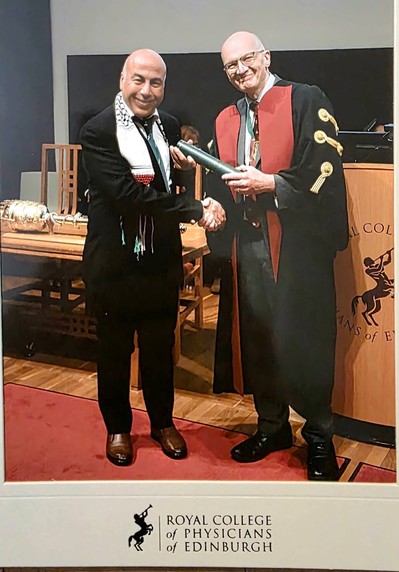
Khamis received his FRCPE award in June this year
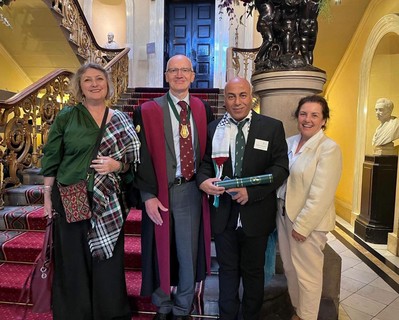
Dr Mhoira Leng and Professor Liz Grant nominated Khamis for this prestigious honour
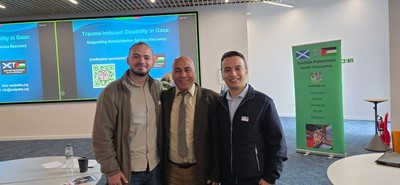
During his visit, Khamis also spoke at the SPHP conference, on traumatic disability in Gaza
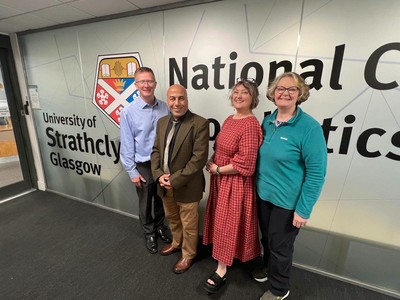
A visit to Strathclyde University prosthesis department
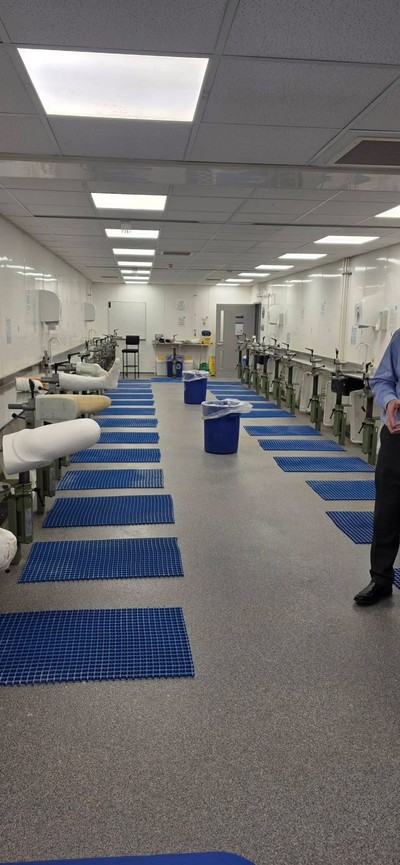
Khamis hopes the technology in use at Strathclyde can help ease the suffering of injured Palestinians
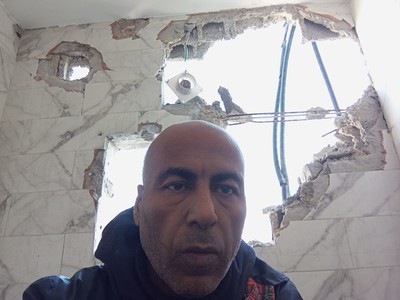
Before leaving Gaza, Khamis was displaced from his home many times
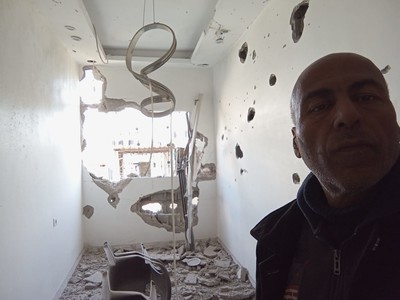
The damage from shells and shrapnel in a residential home