

Blog: Conference Report - ‘Palliative Care: rethinking coping, exploring hope, in the midst of conflict and change.’ by Michelle McGannan
 Cameron Don
 26th March 2026
In February, Cairdeas joined with Ednburgh University's Global Health Academy & PallCHASE (Palliative Care in Humanitarian Aid Situations and Emergencies) to host a hybrid conference, entitled 'Palliative Care: rethinking coping, exploring hope, in the midst of conflict and change.' This conference was a wonderful time of community among the global movement to make palliative care accessible to all, and we were delighted to help bring together so many friends and colleagues from over the years, to discuss this most pressing global health challenge.
Michelle McGannan, one of the conference's organising committee members and a member of PallCHASE, wrote this report on the conference for the e-hospice and kindly agreed to share it with us, so we could bring some of the content from the conference to our supporters.
The Global Health Academy (GHA) at University of Edinburgh, PallCHASE (Palliative Care in Humanitarian Aid Situations and Emergencies) and Cairdeas International Palliative Care Trust were delighted to jointly undertake this hybrid conference. We were joined by 26 participants in-person in Edinburgh, Scotland, and 43 online from countries including South Africa, Lesotho, Malaysia, Mozambique, Jordan, Kenya, Ghana, Ukraine, Germany, Dubai and Egypt.
The conference began with a welcome by Prof Liz Grant (Scotland), where the importance of compassion in both responding to, and taking action to alleviate, suffering was emphasised, with participants being challenged to consider what action can be undertaken individually and collectively.
The plenary sessions commenced with Dr Mhoira Leng (Scotland, Gaza and Uganda) setting the context of palliative care in humanitarian crises/conflict settings, including a focus on non-communicable diseases and holistic needs, with an emphasis on the need to hold onto our shared humanity. Practice exemplars from Sudan and northern Uganda were shared, emphasising the importance of the emerging evidence base. The 2024 WHO report ‘In the Line of Fire’ which outlines the ever-increasing attacks on healthcare workers in conflict zones including Gaza, Ukraine and Myanmar, was shared. Powerful personal experiences of supporting palliative care development and medical student education in Gaza were outlined, concluding with one student’s description of palliative care as ‘humanity until infinity’.
Dr Yasser Abu Jamieh (Gaza and Italy) presented ‘Gaza Community Mental Health programme. Rethinking trauma and healing’. A reminder of the challenges experienced in Gaza prior to October 2023, was shared, with the impact of the subsequent conflict including widespread destruction of infrastructure and multiple displacements of people. Powerful children’s art therapy was presented, demonstrating the internal and external impacts of the war, highlighting the magnitude of internal pain experienced. The ongoing impact of collective trauma, in both adults and children, was outlined, and the strength of community and family support emphasised. The critical importance of mental health interventions during crisis and trauma was outlined, especially pertinent in Gaza due to the relentless impact of multiple traumas from ongoing conflict. The session concluded emphasising the equality of all people.
Rev Rick Bauer’s (USA and East Africa) session focused on integrating spiritual and existential care in the midst of conflict and trauma. Participants were challenged to consider how they can support people dealing with loss and grief in situations of unimaginable devastation, with the importance of listening to, being alongside and not running away from, people experiencing spiritual distress in conflict and trauma being subsequently emphasised. Healthcare workers were also reminded to both recognise, and value, their own humanity as much as their clinical skills. The relatively new field of disaster spiritual care was shared, with the challenges of how to create space for prayer and ritual in the midst of disaster, in addition to providing a source of hope, being discussed.
The second part of the morning session comprised a series of short online recorded interviews with doctors sharing their experiences of working in conflict zones. Prof Khamis Elessi (Gaza and Jordan) was interviewed by Dr Mhoira Leng and stressed that humanity is a critical component of the healthcare role, to subsequently enable appreciation of the suffering experienced by others. He reminded participants of the obligations we have to care for all people, wherever they are, and to maintain hope for a better future.
Dr Nahla Gafer (Sudan and Egypt) was also interviewed by Dr Mhoira Leng and shared her personal journey of displacement in Sudan during the conflict, in addition to her work in cancer and palliative care. Her learning from both these experiences included the importance of information giving, communication and connection with family and colleagues.
Dr Olena Riga (Ukraine) was interviewed by Joan Marston (South Africa) and outlined the importance of developing an action plan for palliative care in conflict, prior to the event. She also shared how she derives hope and energy from patients and their families, in addition to collaborations with local and international colleagues.
Discussions, both in-person and online reflected on the powerful sessions and considered individual response. Areas addressed included the importance of locally led, contextual palliative care programmes being integrated in primary care systems and emergency response, and the importance of humanity and compassion on both a local and global scale.
The afternoon session was purely in-person and comprised a series of short presentations, interspersed with discussion.
Dr Anna Cleminson’s (Ireland) presentation focused on palliative care education in conflict, sharing experiences from Gaza. The importance of joint working between local and international colleagues and the two-way learning that took place was emphasised. The need for trauma sensitive crisis support was highlighted, in addition to supporting sustainable education approaches that were appropriate to the conflict setting.
Dr. Nuhamin Gebre (Ethiopia) gave an overview of her PhD research, exploring digital health in palliative care. The development, testing and launch of a mobile App in Ethiopia was outlined, with conference participants expressing interest in learning more about the App and potential transferability to a UK setting. Dr Gebre also emphasised the importance of empowering community health workers in Ethiopia.
Further discussion included an update on current bereavement research in Africa, with a focus on empowering communities to support in loss. The traumatic impact of both uncertainty and grieving when there is no actual body present to mourn, in conflict settings, was also considered. Additionally, the importance of helping people remember through silence and ceremony, and the question of how to incorporate ritual into individual and collective bereavement was also deliberated.
The conference concluded with a reminder of both the value of our collective humanity and compassion, and of the need for healthcare workers in situations of conflict and trauma to ensure they care for their own soul/spirit to enable them to continue in their work.
Thank you again to Michelle for sharing this excellent report with us, and for all her hard work in organising the conference, as well as the rest of the organising committee. We hope you have picked up a flavour of the topics and discussions and will join us for future conferences. Video recordings of the morning plenaries will be available soon on our website, keep an eye on social media channels and our newsletter for more info.
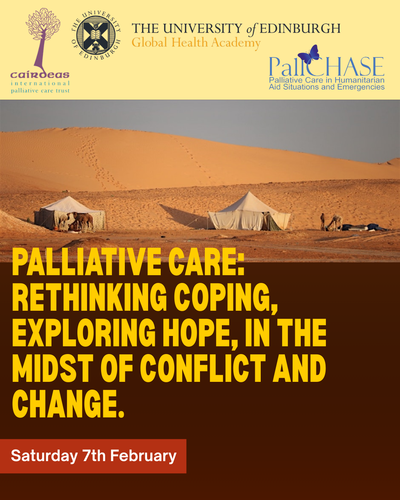
Conference Poster
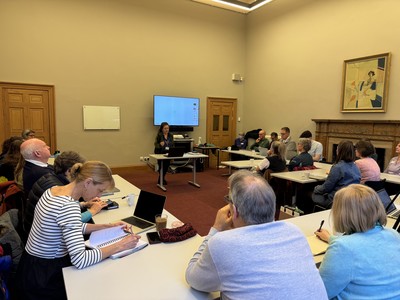
Prof Liz Grant welcoming attendants to the conference
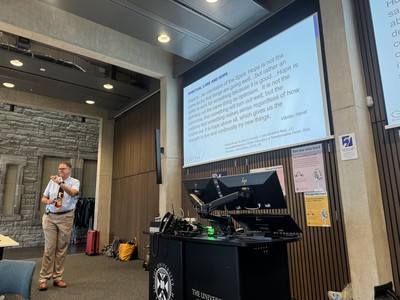
Rev Rick Bauer delivering a talk on integrating spiritual care into palliative care
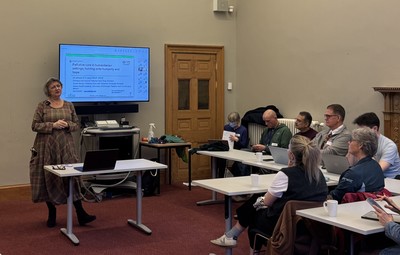
Dr Mhoira Leng speaking on palliative care in humanitarian emergencies
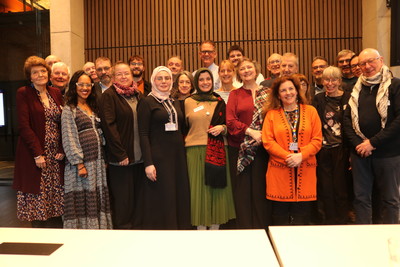
Some of the attendants at the Roundtable discussion